If you are applying to private schools in the Bay Area, you have probably run into a line on the checklist that stops you short.
Somewhere between the application fee and the parent essay, a school asks for the results of an IQ test, or "cognitive assessment," administered by a licensed psychologist. For a lot of families, this is the first time the idea has ever come up, and it lands with a jolt. Testing? For a four year old? What is it, what does it measure, and what happens if my child has an off day?
I test children for private school admissions as part of my practice, and I want to take some of the mystery, and most of the worry, out of it. Here is what an admissions IQ test actually is, why schools ask for one, and what the day looks like for your child.
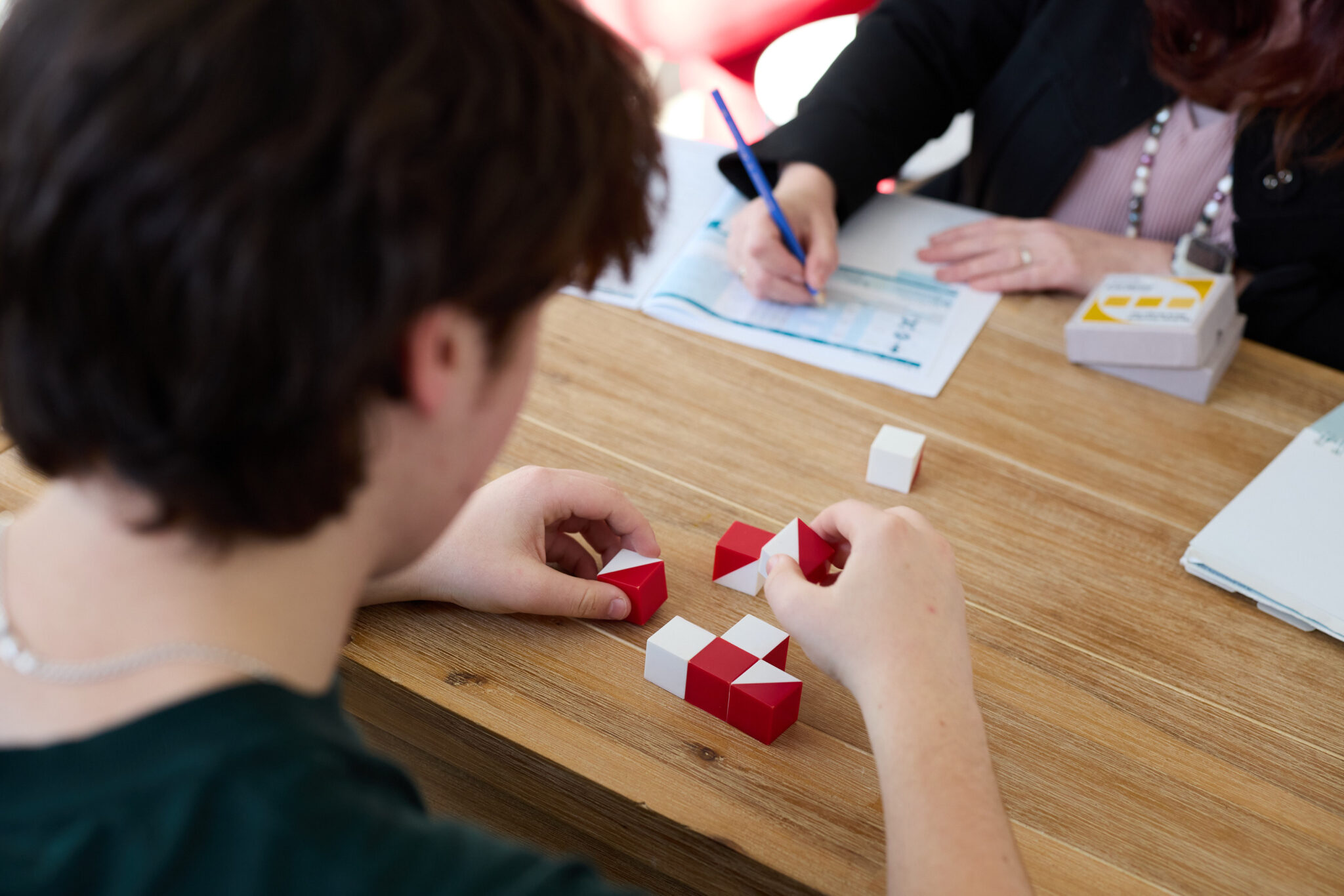
To your child, it does not feel like a test. It feels like an hour of puzzles and games with a friendly grown-up. That is by design.
Why do private schools ask for an IQ test?
It can feel strange for a school to want a cognitive score before they have even met your child. But the reasoning is fairly practical.
Admissions offices are comparing applicants from dozens of different preschools and elementary schools, each with its own grading, its own teachers, and its own idea of what "doing well" looks like. A grade of "meeting expectations" at one program is not the same thing at another. What admissions lacks is a common yardstick.
A standardized IQ test gives them that. The WPPSI-IV and the WISC-V are normed on thousands of children, so a result tells the school how your child reasons and solves problems compared to other kids the same age, measured the exact same way for every applicant. It is not there to rank children or to sort out the "smart" ones. It is one objective data point that helps a school understand how a child thinks and whether their program is a good fit.
Just as importantly, it is only one piece. Every school I work with weighs the test alongside the classroom visit, the application, and teacher reports. No good admissions office decides on a single number.
Which test will my child take, the WPPSI-IV or the WISC-V?
Both are published by the same test-maker and are considered the gold standard for cognitive assessment. Which one your child takes comes down to age.
- WPPSI-IV. The Wechsler Preschool and Primary Scale of Intelligence, for ages 2 years 6 months through 7 years 7 months. This covers most preschool, TK, and kindergarten applicants.
- WISC-V. The Wechsler Intelligence Scale for Children, for ages 6 through 16. This covers elementary and middle school applicants.
There is an overlap around ages six and seven, and the psychologist chooses the version that best fits your child and matches what the school has asked for. Some schools name the test they want in their materials. If yours does not, a quick email to the admissions office settles it, and it is a normal question to ask.
What is the test like for my child?
This is the part parents most want to know, and it is usually the most reassuring. It is not a written exam, and your child does not need to prepare a single thing. They sit one on one with the psychologist at a table and work through a mix of short, hands-on and spoken activities that feel far more like play than like a test.
Most children finish in a single session of about 80 minutes, with breaks whenever they need one. A skilled examiner keeps the pace comfortable, builds rapport first, and knows how to keep a young child engaged. To your child, it genuinely feels like an hour of puzzles and games with a nice adult, which is exactly how it should feel.
I keep the specifics of the tasks private on purpose. These tests are only meaningful when a child comes in fresh, so rather than walking through exactly what is on it, the most useful thing I can tell you is that there is nothing to study and nothing to rehearse.
Can you prepare for it? (And should you try?)
The honest answer is no, and I would gently steer you away from any program that promises to prep or coach your child through one.
These tests are designed to measure how a child reasons, not what they have memorized. Drilling flashcards or running practice sets does not reliably raise a genuine score, and it can backfire. A child who has been over-rehearsed sometimes looks anxious or rote in ways that muddy the picture, and an inflated result that lands a child in a program that is not the right fit helps no one, least of all the child.
What actually helps is simple and human:
- Sleep and breakfast. A rested, fed child performs like themselves. This matters far more than anything academic.
- Keep it low key. Tell your child they are going to play some thinking games and puzzles with a friendly grown-up. Skip the word "test" and skip the pressure.
- Time it well. Book the appointment for when your child is usually at their best, often the morning, not right after a busy weekend or a missed nap.
That is the whole preparation checklist. If a child arrives rested and relaxed, they will show what they can do.
What you walk away with
After testing, you receive a written report with your child's scores, prepared in the format schools expect and ready to submit with the application. At Clarity, we will get you the results within 3 business days, which matters when admissions deadlines are close together.
The report is yours. You decide which schools receive it, and the same results can often satisfy more than one school's requirement. If anything unexpected shows up in how your child processes information, you will hear about that too, in plain language.
What the score does, and does not, decide
It is worth holding on to this: the number is a snapshot of how your child reasoned on one morning, not a verdict on who they are or how far they will go. Bright, wonderful kids have quiet days, and no responsible admissions office treats a single score as destiny.
Schools read the result in context, next to the visit, the teacher input, and everything else in the file. My job is simply to give the school an accurate, well-administered picture, and to make sure your child has the calm, unhurried setting they need to show what they can do. If you would like to know how a specific school uses the results, ask them directly. In my experience they are used to the question and happy to answer.
Frequently asked questions
How much does private school IQ testing cost, and how fast are results?
At Clarity, admissions IQ testing is a flat $800, which includes the session and the written report. Most children finish in a single visit of about 80 minutes, and we will get you the results within 3 business days so you can meet application deadlines.
Who is allowed to administer the test?
Schools generally require a licensed professional, such as a Licensed Educational Psychologist or clinical psychologist, not a tutor or teacher. At Clarity, testing is conducted by Claire McCann, LEP #4820, and Sierra Delaney, LEP #4856.
Can one test be used for more than one school?
Often, yes. Many schools accept the same WPPSI-IV or WISC-V results, so a single report can frequently be submitted to several schools. Check each school's requirements, since a few name a specific test or a recency window.
What if my child has an off day?
An experienced examiner is trained to notice when a child is tired, shy, or not engaging, and will note it. If a result clearly does not reflect your child, we can talk through options. This is also why arriving rested and relaxed matters more than any prep.
Do you have guides for specific schools?
Yes. We keep up-to-date pages for individual Bay Area schools with their testing requirements and key admissions dates. See our IQ and private school testing page for the current list.
Leave a Comment
Your email address will not be published. Required fields are marked *